

Choosing a riflescope is one of the most important decisions a South African hunter or sport shooter will make. The right scope makes the difference between consistent hits at 600 metres and frustration at 250. The wrong one wastes thousands of rands and turns a good rifle into a disappointment.
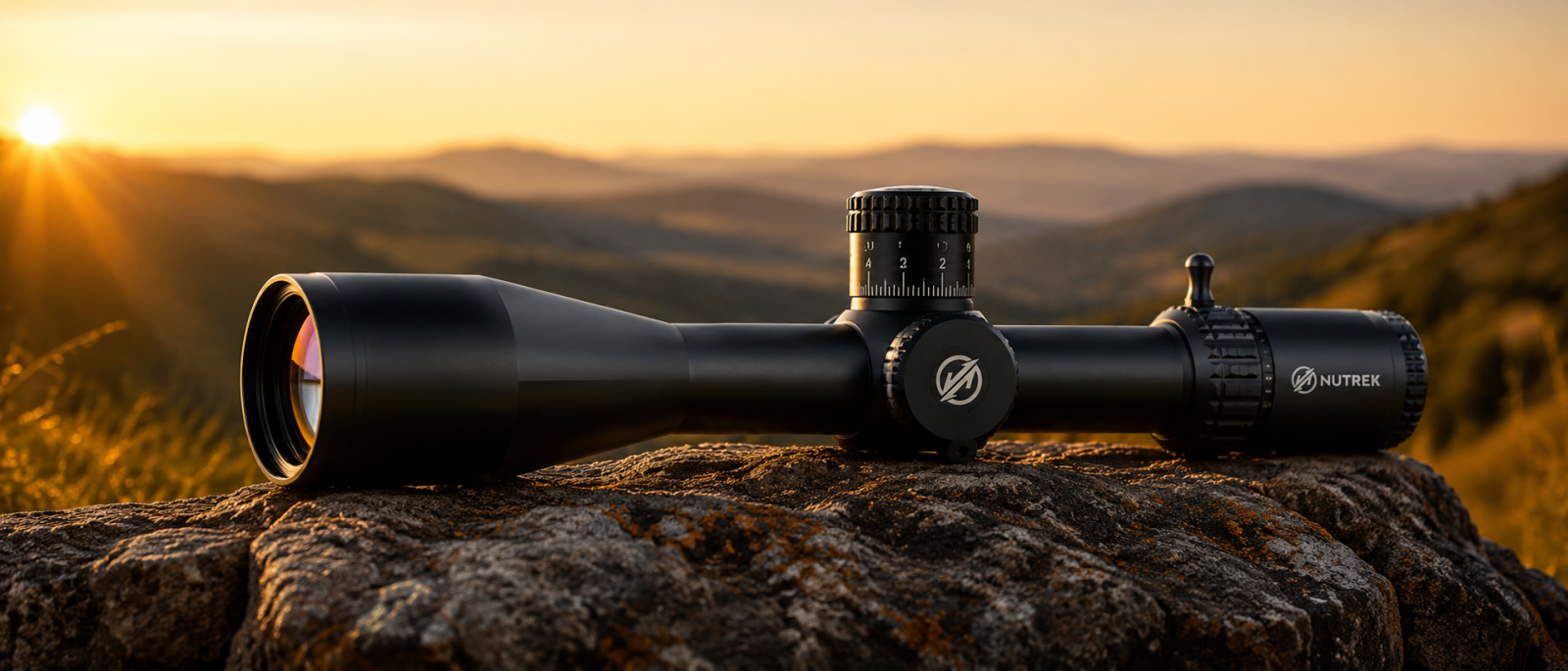
This guide walks through everything you should consider before buying a long-range scope, using the Nutrek Coppertag 5-25x56 as a real-world reference point — a scope built squarely for the long-range hunting and precision target work that South African conditions demand.
What does "5-25x56" actually mean?
Three numbers describe almost every modern scope:
- 5-25x is the magnification range. The scope can dial from 5× (5 times the size you see with the naked eye) all the way up to 25×.
- 56 is the objective lens diameter in millimetres — the front lens that gathers light. A 56 mm objective is on the larger side and excellent for dawn and dusk shooting, which is when South African plains-game hunting tends to happen.
The combination is purpose-built: a wide low-end (5×) for snap shots in thicker bushveld, and serious magnification (25×) for verifying placement at extended ranges.
Magnification: how much do you actually need?
A surprising number of hunters over-buy magnification and end up shooting most of their game at 8-12×, even on a scope that dials to 25×. The reason a wide variable like 5-25× is still worth the money is flexibility, not maximum power. You want enough top-end to confirm shots at distance, and enough bottom-end to use the same rifle for closer work.
Rough rules of thumb:
- 1-6× / 1-8× — Close range, driven hunts, dangerous-game backup
- 2-12× / 3-15× — General hunting from 50 m to about 400 m
- 4-16× / 5-25× — Plains-game hunting plus long-range target work
- 5-25× and above — Precision rifle shooting, varminting, F-Class style work
If your typical day involves shots between 100 and 500 m on kudu, blesbuck or springbok, a 5-25× scope like the Coppertag covers everything you'll encounter and leaves headroom for the longer stuff.
Objective lens size: bigger isn't always better
A 56 mm objective gathers more light than a 40 mm or 50 mm. In low-light conditions — first light, last light, overcast — the difference is visible. The trade-offs are:
- Higher mounting height — you'll likely need medium or high rings, and your cheek weld changes
- More weight — heavier rifle, more fatigue on long days
- Bigger profile — slightly more conspicuous in a hide
For dedicated long-range work or hunting that includes low-light edges of the day, 56 mm is the right choice. For an everyday brush gun, 40-44 mm is usually plenty.
First focal plane vs second focal plane
This is the single most-confused topic in scope-buying, and getting it wrong means your reticle subtensions are unreliable.
- First focal plane (FFP) — the reticle grows and shrinks with magnification. Your mil or MOA hash marks are accurate at every power setting. Essential for ranging and hold-overs at varying magnifications. Standard for tactical and serious long-range scopes.
- Second focal plane (SFP) — the reticle stays the same visual size. Hash marks are only accurate at one magnification (usually the maximum). More forgiving on low-power varieties, but limiting if you dial.
For a 5-25× scope used at varying ranges, FFP is what you want. Verify on the product page or with the dealer before buying.
Reticles: pick one you understand
A great reticle is one you can read instantly under pressure. The wrong reticle is information overload that costs you the shot.
Common patterns for long-range work:
- MOA-based grids — match common click values, simple geometry
- MIL / MRAD grids — favoured by precision shooters, easy mental maths at distance
- Christmas-tree style — adds horizontal wind hold references below centre
Whatever the marking system, the reticle should be illuminated for dawn and dusk shots, with a brightness control that goes from "barely on" to "stand out against bright sky". A reticle that's too bright at low light bleeds into the target.
Turrets: tactile, audible, repeatable
Long-range work means dialling, which means the turrets matter as much as the glass. Look for:
- Crisp, tactile clicks — you should feel each click distinctly without looking down
- Audible clicks — quiet enough not to spook game, loud enough to count
- Zero-stop function — return to zero without counting revolutions
- Locking turrets — prevent accidental adjustment from brush and slings
- Matching click value to your reticle — MOA reticle with MOA turrets, MIL reticle with MIL turrets
Tracking accuracy — does 10 clicks of "up" actually move the impact 10 clicks worth? — is the single most important characteristic of any precision scope. This is something to confirm on the manufacturer's spec sheet or in independent reviews before you buy.
Glass quality and coatings
Glass is where the real cost of a scope lives. Better glass gives you:
- Brighter image, especially at the edges
- Better resolution at high magnification
- True colour rendition (no green or blue tint)
- Less mirage and chromatic aberration
You can compare scopes objectively: dial to maximum magnification, focus on a distant object with text or fine detail, and compare how clean the image is right out to the edges of the field of view. Pay attention to how the image holds up when you turn the brightness up — cheap glass loses contrast in bright conditions.
Tube diameter
The Nutrek Coppertag 5-25x56 uses a 34 mm main tube (verify on the product page). 34 mm tubes typically offer more vertical adjustment travel than 30 mm tubes, which matters when you're zeroed at 100 m and dialling out to 800 m+. They also need 34 mm rings — make sure your mounting solution matches.
The South African context
A few things worth thinking about specifically for SA conditions:
- Long, glaring sunlight — coatings that handle bright light matter more here than in cooler northern climates. Bring a sunshade.
- Dust — choose a scope with positive turret seals and capped exposed adjustments unless you're cleaning them often.
- Mixed terrain — a wide magnification range (like 5-25×) means one scope for thick bush, kopjes, and open plains.
- Common cartridges — for typical SA cartridges (.308, .30-06, 7mm Rem Mag, .300 WSM), a 5-25× scope is perfectly matched. For .22 LR or .223 plinking, this is more scope than you need.
Mounting matters as much as the scope
A R30,000 scope on R200 rings is a R30,200 problem. Spend properly on:
- Quality rings in the correct tube diameter (34 mm for the Coppertag) and correct height for your objective
- A solid one-piece base lapped flat to the action
- Torque the screws to spec — over-tightening crushes tubes; under-tightening means walking zero
A bubble level fitted to the scope or rings is also worth its weight in gold for long-range work where cant introduces lateral miss.
Who is the Nutrek Coppertag 5-25x56 for?
It's the right scope for:
- Plains-game hunters who occasionally shoot past 400 m
- Precision target shooters working on long-range fundamentals
- Anyone wanting one scope to cover both stalking and varmint distances
It's overkill for:
- Close-range dangerous-game work (a 1-6× is better)
- .22 LR plinking
- Lightweight stalking rifles where every gram counts
Final word
The right scope is the one that matches your typical shooting distance, your light conditions, and your willingness to dial versus hold. For a South African hunter who wants flexibility from 100 m out to genuine long range, a 5-25×56 scope like the Nutrek Coppertag is in the sweet spot of capability and value.
If you're not sure which configuration fits your rifle and your shooting style, contact us before you buy — we'd rather sell you the right scope once than the wrong one twice.